Security Solutions
When haze affects Singapore, one of the first things we notice is reduced visibility. Buildings in the distance become less distinct, objects appear less defined, and details that are normally easy to see may become increasingly difficult to distinguish.
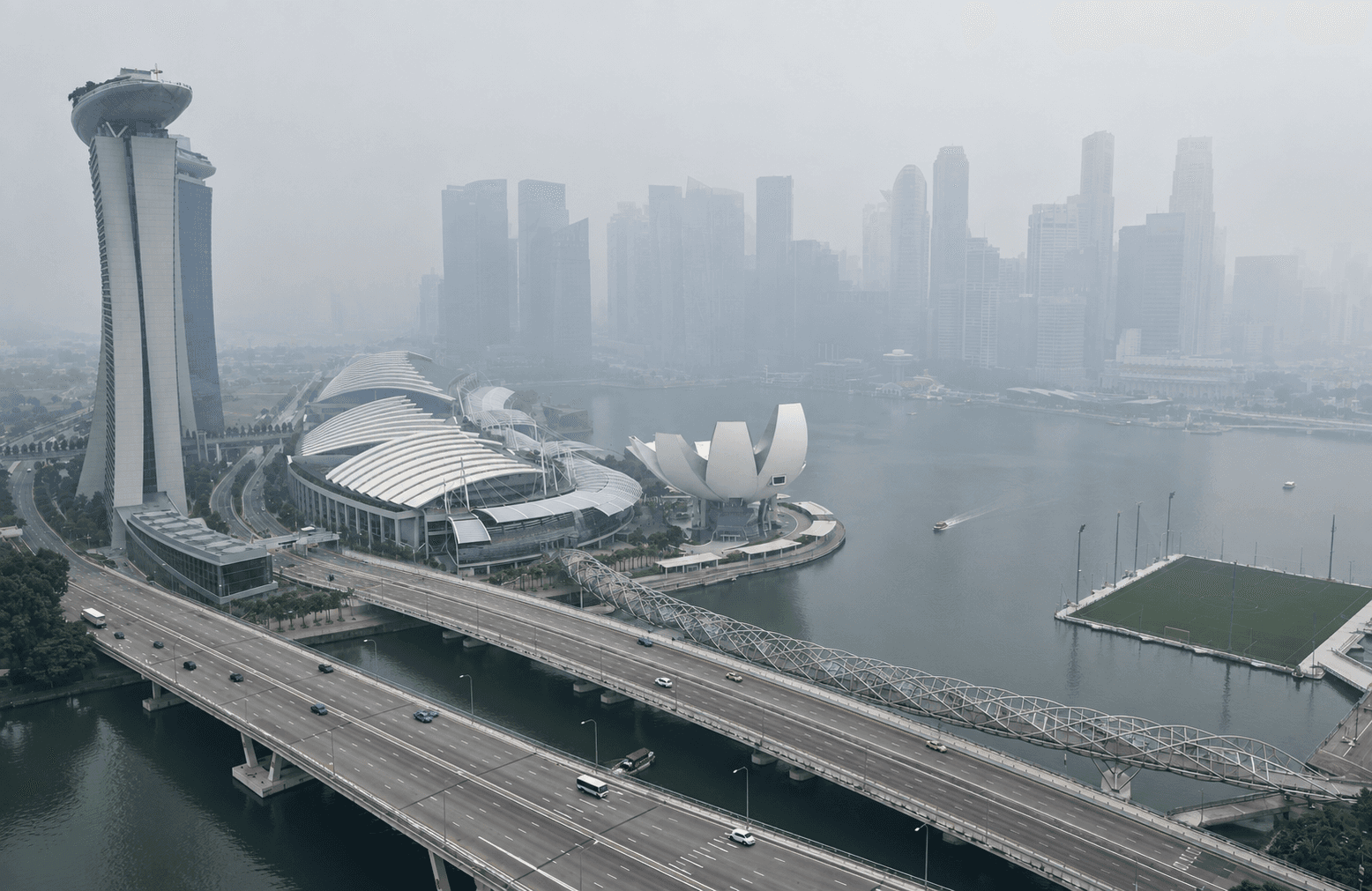
Singapore’s National Environment Agency (NEA) explains that visibility can be affected by smoke haze and humidity because particles and water droplets scatter light. Poor visibility alone should not be treated as a direct measure of air quality.
But from a security perspective, this raises another question:
If our eyes struggle to see clearly through haze, what happens to CCTV cameras?
For organisations relying on outdoor video surveillance in Singapore, the answer depends on the camera technology, environment, distance and — most importantly — what the surveillance system is expected to achieve.
How Does Haze Affect CCTV Cameras?
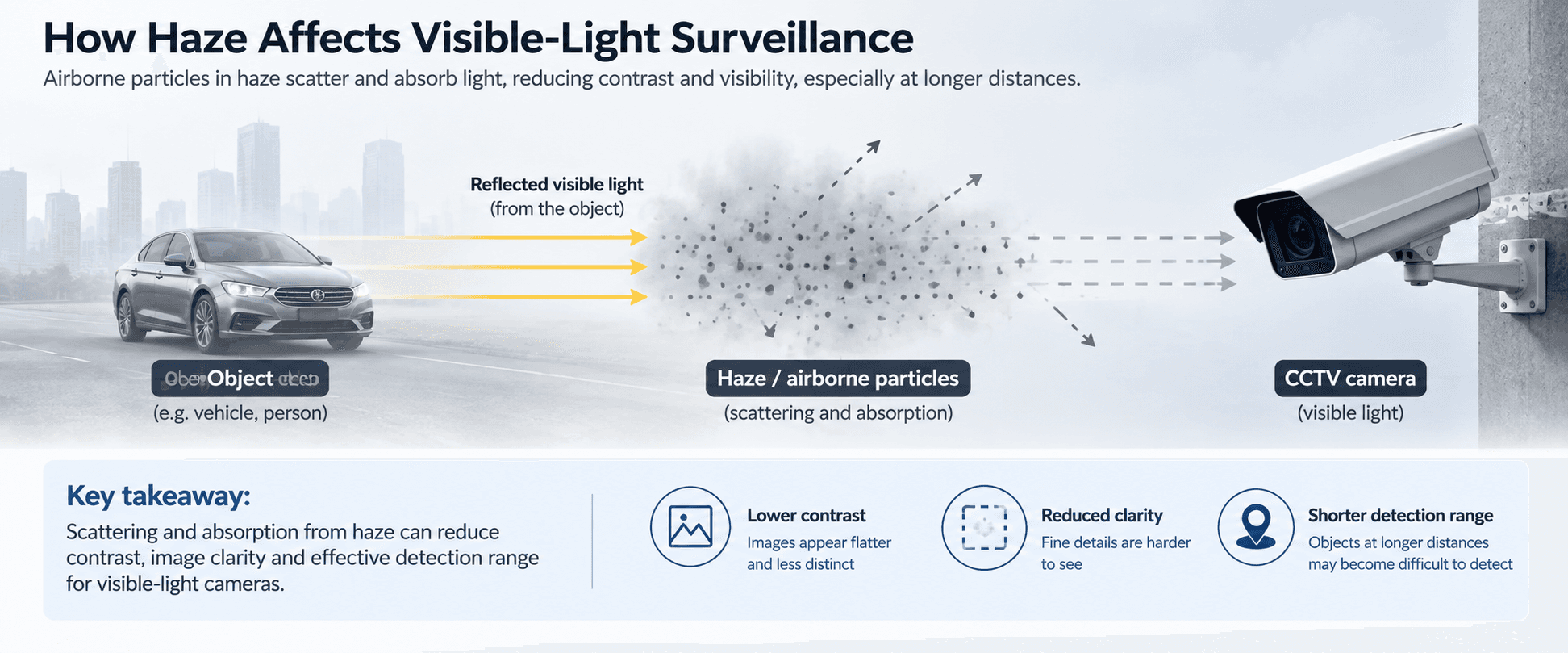
Haze scatters and absorbs visible light, which lowers contrast and can shorten the distance at which a conventional CCTV camera can reliably detect or identify objects. How much this matters depends on the camera type, the distance involved and how dense the haze is.
Conventional visual cameras rely on light from the scene reaching the camera sensor. When particles or droplets are present in the atmosphere, light can be scattered or absorbed. As visibility deteriorates, contrast can decrease and objects at a distance can become harder to distinguish.
This means atmospheric conditions should be considered when planning outdoor CCTV, particularly for applications involving longer distances, perimeter surveillance and large outdoor environments.
However, not every camera sees the world in the same way.
Visual vs Thermal Cameras: What’s the Difference?
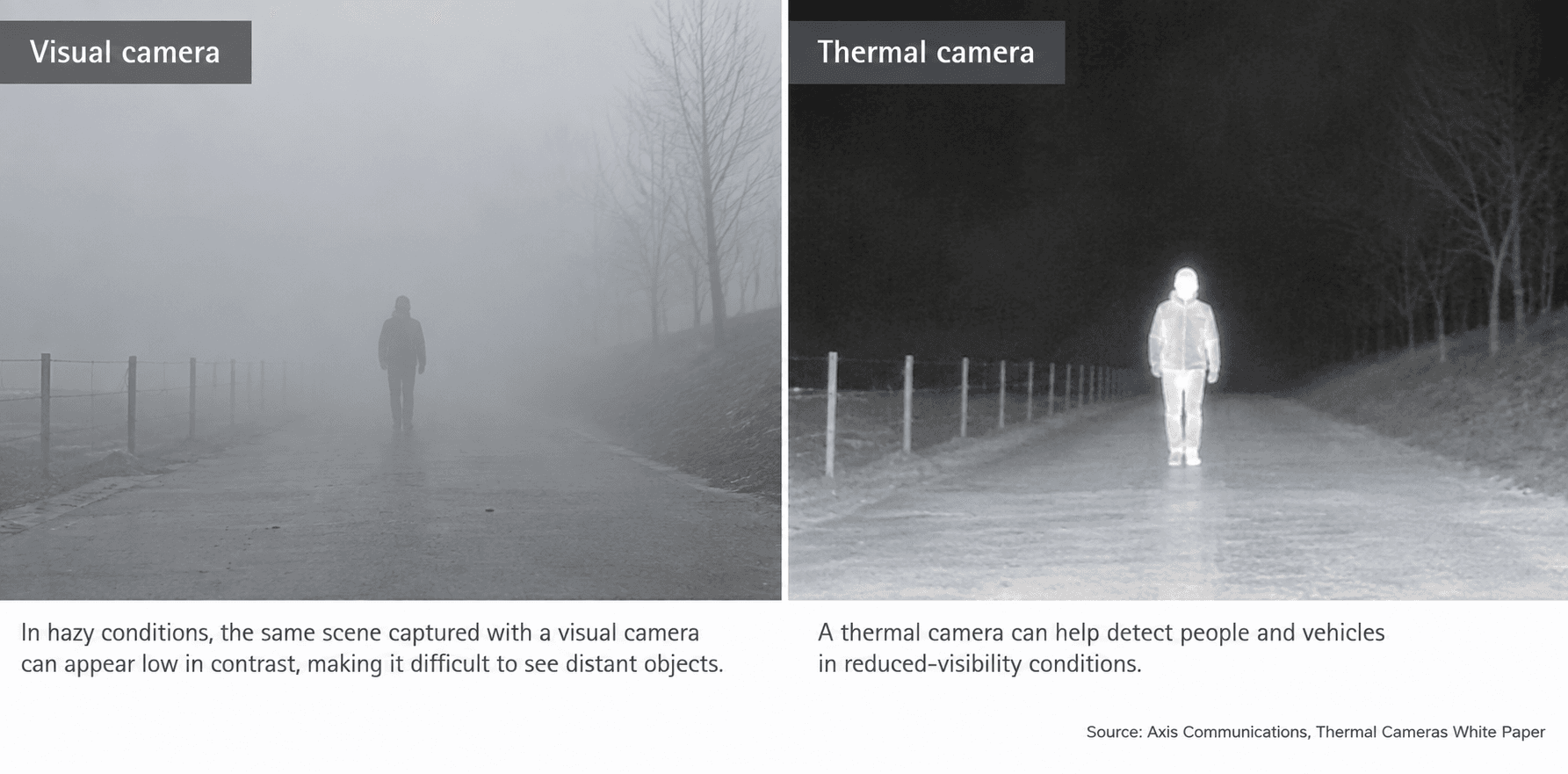
A conventional surveillance camera and a thermal camera capture very different information.
Visual cameras primarily use visible light reflected from objects to produce an image. Thermal cameras, on the other hand, detect thermal radiation emitted by objects.
This difference becomes particularly relevant when environmental conditions reduce visibility.
Axis Communications explains that its thermal cameras primarily operate in the long-wave infrared (LWIR) range. According to its thermal camera white paper, LWIR wavelengths generally have better transmission than visible wavelengths in conditions involving airborne particles. As a result, the detection range of a visual camera can sometimes be reduced more significantly than that of a thermal camera — an important consideration for thermal camera deployments in Singapore’s haze-prone climate.
Can a Thermal Camera See Through Haze?
Not quite — and this distinction matters.
Thermal imaging should not be treated as technology that simply “sees through” any haze or fog. Axis notes that fog, smog and haze can all reduce thermal detection range. The degree of impact varies according to particle size, concentration and environmental conditions.
In lighter fog conditions, Axis technical data shows a substantial difference between visible-light and LWIR range. In dense fog, both are significantly affected and the difference becomes much smaller.
Thermal can improve detection under certain reduced-visibility conditions — but it does not make atmospheric conditions disappear.
Actual performance can also depend on factors such as target-to-background temperature difference, distance, physical installation, camera selection and objects within the scene. For system integrators and end users, camera selection should therefore start with the application requirement rather than a single specification.
Detection Is Not the Same as Identification
A security team might need to answer: “Is somebody there?” That is primarily a detection question. But they may subsequently need to answer: “Who is the person?” That is an identification question.
Thermal cameras can be highly useful for detecting people and vehicles under challenging lighting and certain weather conditions. However, thermal imagery is generally not intended to identify a specific individual in the same way a suitable visual camera may be used for identification.
That is why the design question is not necessarily Visual OR Thermal. Depending on the application, the better architecture may involve Visual + Thermal + Analytics + Video Management.
From Camera Detection to Security Response
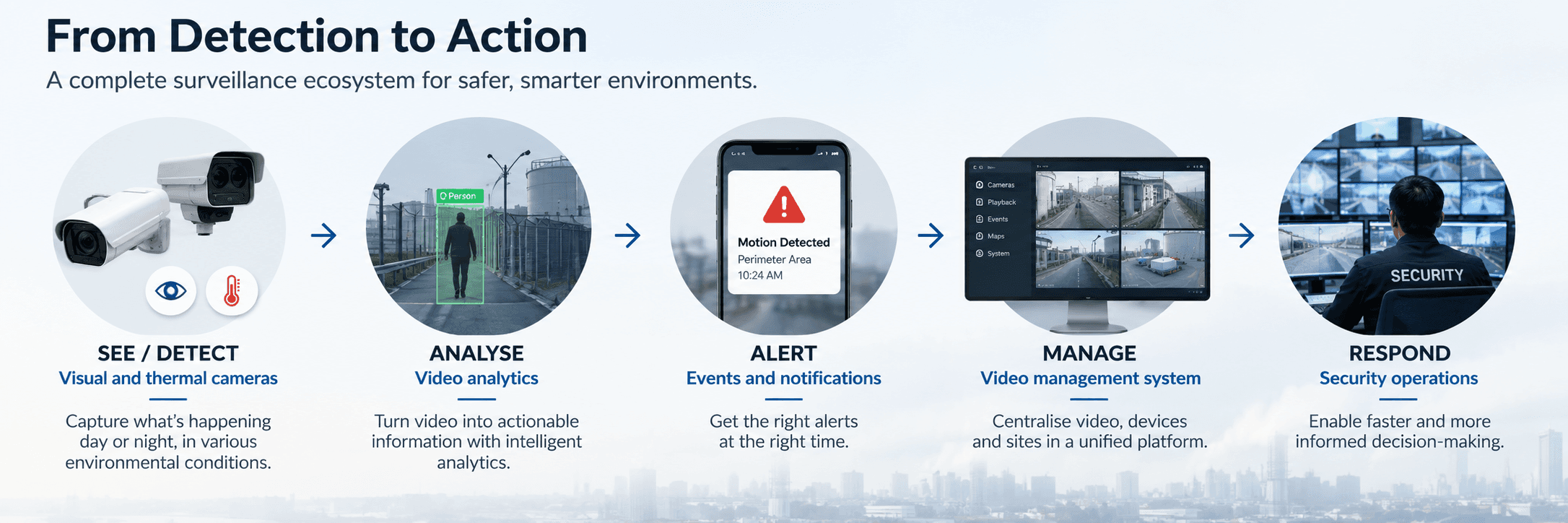
A modern surveillance system does not end at the camera. The camera may detect an event, but organisations still need to analyse that event, notify the appropriate people, manage video and enable an effective response. This is where an integrated surveillance architecture becomes important.
Milestone XProtect can be introduced here as an example of a video management system (VMS) used in Singapore deployments, bringing cameras, sensors, analytics and sites into a centralised platform.
Choosing the Right Surveillance Technology for Your Environment
There is no single security camera configuration in Singapore that is right for every environment. A warehouse perimeter may have different requirements from a commercial building. A critical infrastructure project may prioritise long-distance detection, while another site may require detailed visual identification, analytics or integration with an existing video management system.
Before specifying a surveillance solution, key considerations can include:
· Required detection, recognition and identification distances
· Day and night lighting conditions
· Haze, fog, rain and other environmental factors
· Camera positioning and lens selection
· Visual versus thermal imaging requirements
· Video analytics and event handling
· Network, storage and cybersecurity requirements
· VMS integration and existing infrastructure
· Scalability and future expansion
D-Ron is a Singapore-based CCTV distributor and value-added technology partner for video surveillance and integrated security systems. We support system integrators, consultants and organisations with access to global security technologies, local expertise and solution-oriented project support.
Explore D-Ron’s Video Security Camera System solutions for more on our camera and surveillance portfolio.
As a distributor across multiple brands and solution categories, our role is not to force one camera or one technology into every application. Instead, we help partners evaluate the requirements first and identify technologies that can work together as part of a scalable surveillance architecture.
The better questions are:
· What needs to be detected?
· At what distance?
· Under what environmental conditions?
· What information does the operator need?
· What should happen after an event is detected?
From visual and thermal cameras to analytics, networking and video management, D-Ron helps bring together technologies from leading global manufacturers to address real-world project requirements.
Visibility changes. Your surveillance strategy should be designed with the environment in mind.
Planning a CCTV or Surveillance Project in Singapore?
Whether you are evaluating visual cameras, thermal imaging, video analytics or a complete video surveillance architecture, speak with D-Ron about the requirements of your project.