Security Solutions
Today’s security landscape warrants careful choice in surveillance systems: NVR vs DVR. Whether upgrading from analogue cameras, expanding your current setup, or implementing advanced security for the first time, this decision affects everything from video quality to scalability.
Let’s explore what these camera systems are and which best match your security requirements and financial considerations.
Understanding DVR Systems
What is a Digital Video Recorder?
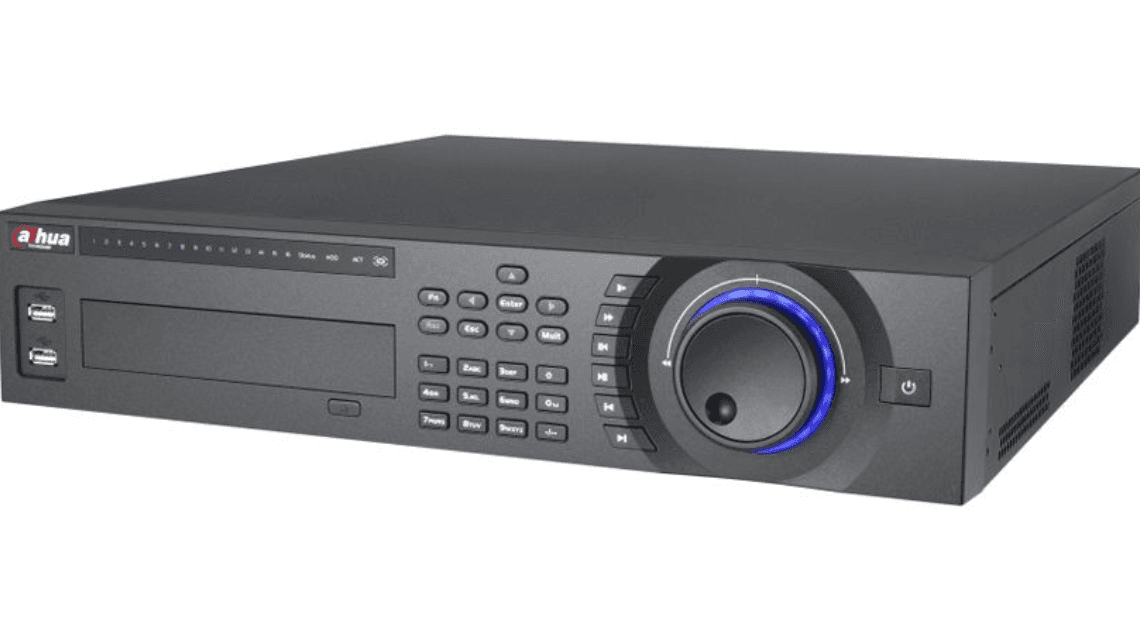
A digital video recorder (DVR) is a surveillance system cornerstone that records and stores video footage on local storage devices like hard drives.
It primarily works with analogue cameras connected through coaxial cables, bridging traditional CCTV systems with digital storage capabilities.
Key Capabilities
Records analogue video feeds and enabling digital storage and manipulation
Supports remote access to footage
Offers advanced search functionality by events, time, and date
Features automatic storage management through cyclical recording
Hardware Features
Rack-mountable design for professional installations
Multiple input support via coaxial/optical connections
External monitor compatibility
PTZ camera control through I/O connections
Security event and connectivity monitoring
Software Advantages
Customisable recording resolution based on user needs or events
H.264 compression for efficient storage
Advanced video analytics including movement tracking
Comprehensive search capabilities
Multi-channel audio recording support
Secure footage archival
How do they work?
Here is a simple way to describe how DVRs work.
Analogue cameras capture video signals, which are then transmitted to the DVR via coaxial cables.
The DVR receives the signals and uses Analog-to-Digital (ADC) to convert them into a digital format.
The digital video data is usually compressed using codecs (like H.264) to reduce file size without sacrificing quality.
The compressed digital video data is stored on a hard disk drive (HDD) or a solid-state drive (SSD) within the DVR.
Users can access the stored video footage through the DVR’s interface, usually a monitor or a computer connected to the DVR.
Advantages of DVR Systems
These are the reasons that make DVRs a viable option for CCTV surveillance.
DVR systems are generally more affordable than NVR systems, especially for smaller installations. This is because analogue cameras and DVRs are cheaper than their IP counterparts.
Coaxial cabling used in DVR systems can be cheaper and easier to install than network cabling for IP cameras.
DVRs function independently of a network connection. This means they are not susceptible to network outages or cyberattacks that could disrupt recording or footage access.
Since the recording and processing happen locally on the DVR, there is no delay in viewing live footage or accessing recordings due to network latency.
DVR systems are often easier to set up and configure, even for those who are less familiar with network configurations.
Many DVRs have user-friendly interfaces that are easy to navigate and understand.
DVRs can be integrated with existing analogue CCTV systems. You can go for a gradual upgrade path rather than replacing the entire system.
DVRs are well-suited for smaller installations with a limited number of cameras, such as small businesses or some areas within larger facilities.
Limitations of DVR Systems
They offer many reliable capabilities, but as with any system, DVR systems also have notable limitations that can affect their sustainability for modern security needs.
Technical Constraints
Limited resolution and frame rates compared to network-based solutions
Audio-recording capability restricted to specific models
Incompatibility with IP cameras, limiting upgrade options
Installation Challenges
Complex wiring requirements, especially for multi-camera setups
Need for local connectivity infrastructure
Separate power supplies for each component
Difficult implementation across multiple locations
Understanding NVR Systems
What is a Network Video Recorder?
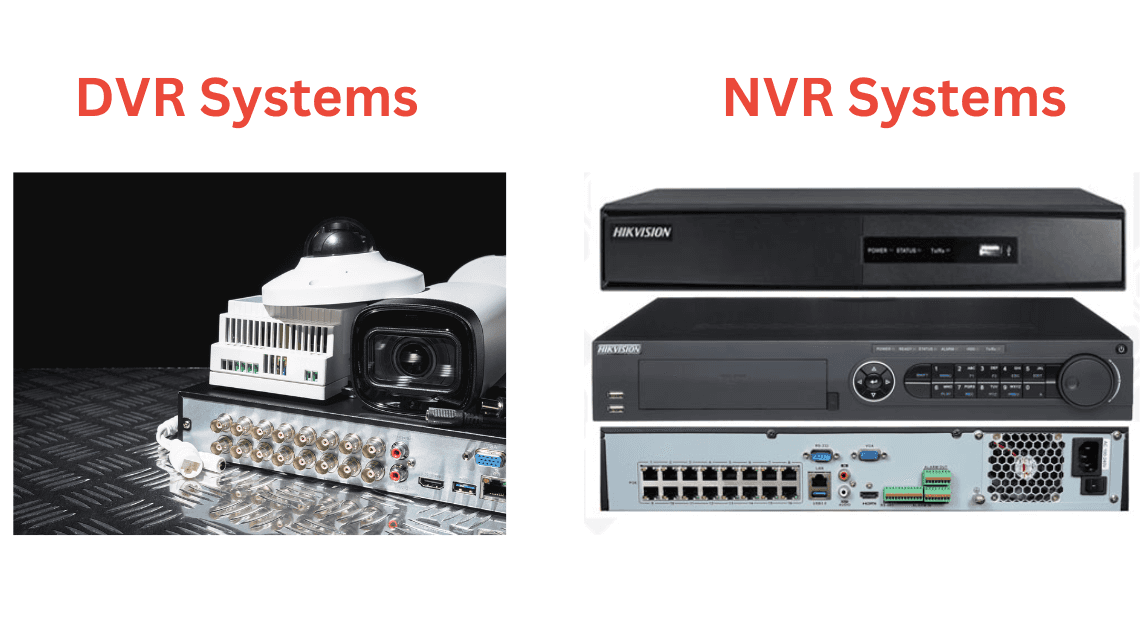
A network video recorder (NVR) is a specialised digital recording system designed for IP-based surveillance. It processes and stores footage transmitted from IP cameras through ethernet or WiFi networks.
Advantages of NVR Systems
The following make an NVR system the better choice for recording footage.
Enhanced video and audio recording capabilities
Superior image quality enabling advanced features like facial recognition
Flexible installation through wired or wireless connectivity
Simplified cabling with PoE support (single cable for video, audio, and power)
Greater system scalability and coverage options
Technical Features
Advanced video analytics
Multiple recording mode options
PoE network switch integration
PTZ camera control capabilities
Remote system configuration
Event-triggered recording
Efficient video compression
The Downsides
There are also downsides to the use of an NVR as a recording system.
NVRs and IP cameras are generally more expensive than their analogue counterparts used in DVR systems.
Setting up an NVR system may require additional networking equipment like switches and routers.
IP cameras may have shorter lifespans than analogue cameras.
High-resolution IP cameras can consume significant network bandwidth.
Network latency can cause delays in live viewing or accessing recorded footage, especially when you are accessing the system remotely.
Assigning and managing IP addresses for multiple cameras can be complex.
Troubleshooting network-related issues in an NVR system may be more complex than a standalone DVR system.
Not all IP cameras are compatible with all NVRs.
Integrating NVR systems with other security systems or platforms may require additional configuration and compatibility checks.
NVR vs. DVR, Side-by-Side
Factor | DVR (Digital Video Recorder) | NVR (Network Video Recorder) |
Camera type | - Analogue cameras | - IP cameras |
Connectivity | - Coaxial cables | - Ethernet/WiFi; Power over Ethernet (PoE) - single cable solution |
Video quality | - Lower resolution | - Higher resolution |
Scalability | - Limited by physical ports | - Highly scalable |
Features | - Basic motion detection | - Advanced analytics |
Installation | - Complex wiring | - Simpler installation |
Cost | - Lower initial cost | - Higher equipment cost |
Storage | - Local storage only | - Network storage options |
Security | - Physical security dependent | - Network security measures required |
Maintenance | - Hardware-focused maintenance | - Software updates and network maintenance |
Future-proofing | - Limited upgrade potential | - Easily upgradeable - Compatible with new technologies |
Choosing the Right System for Your Business
When choosing between NVR and DVR systems, here are the factors you should carefully consider to ensure that your investment aligns with current needs and future growth.
Business Scale and Requirements
Consider your current employee count, operating hours, and the nature of assets that need protection. A small shop may have different needs compared to a warehouse or multi-location enterprise.
Surveillance Coverage
Assess the areas that need to be monitored, both indoors and outdoors. The climate in Singapore demands weather-resistant cameras for outdoor surveillance, while indoor spaces need varying coverage densities based on security priorities.
Budget Considerations
Initial costs matter, but it’s important to consider long-term expenses, including installation, maintenance, and potential upgrades. The strict security compliance requirements in your industry may influence your investment decisions.
Infrastructure Assessment
Evaluate your existing network capabilities and physical infrastructure. Modern buildings often support IP-based systems. Older properties might be better suited for traditional setups.
Specific Recommendations
For small businesses, for example, if you are running a small retail outlet or F&B establishment with basic surveillance needs, a DVR system might be sufficient. It offers lower initial costs and adequate security coverage for single-location operations.
Consider this option if you have:
Limited surveillance points (under eight cameras)
Basic security requirements
Budget constraints
Existing analogue infrastructure
For medium to large enterprises like businesses with multiple locations or needing high-quality surveillance like shopping centres, hotels, or manufacturing facilities, business owners should consider NVR systems.
An NVR system offers…
Superior image quality for facial recognition
Centralised management across locations
Advanced analytics for business insights
Scalability for future expansion
Forward-thinking businesses should lean toward NVR systems, particularly if planning:
Business expansion
Integration with smart building systems
Advanced security features implementation
Compliance with evolving regulations on security
Conclusion
Effectively securing your business means choosing between these two systems based on your needs. Consider your current requirements, but also plan for future expansion.
D-Ron’s team of experts is ready to help you decide and implement the most suitable solution for your business security needs.
Contact us today for personalised guidance on selecting and implementing your CCTV surveillance system in Singapore.