Security Solutions
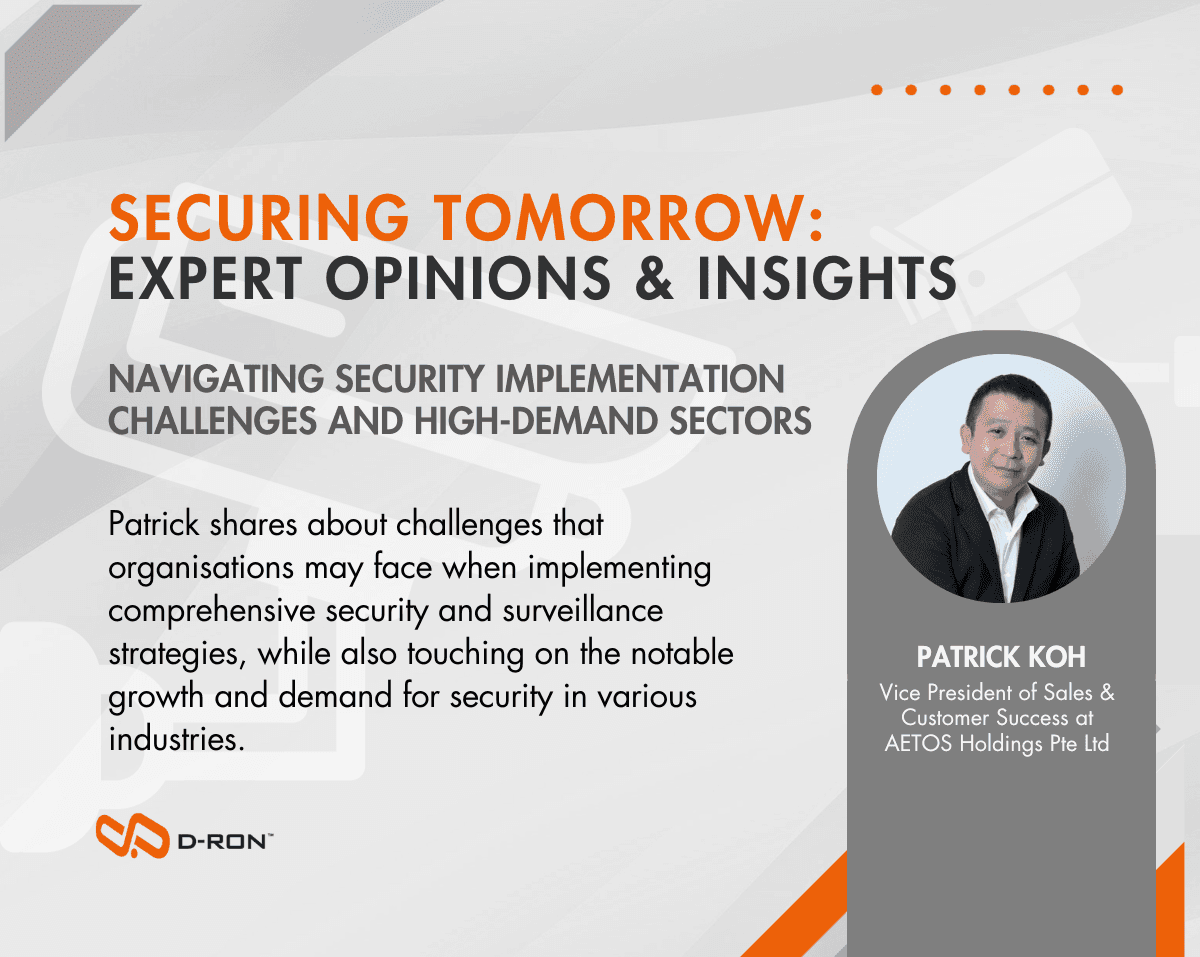
D-Ron: What is your view of the potential market growth for the video surveillance market in Singapore and/ or Southeast Asia for 2024 and 2025?
Patrick: My view is that the growth in the region will be quite significant, not only for 2024 and 2025 but at least for the next 5 to 10 years. This is because research has shown that the compound annual growth rate (CAGR) of the video surveillance market in Southeast Asia for the next five years is forecasted to be at a double-digit growth, between 10 and 14%.
Actually, this is not really surprising. If you look at most Southeast Asian countries, many of their government initiatives are focused around urbanisation, infrastructure development, smart cities, public security, and safety. All these are certainly key drivers for the increased demand of video surveillance technology.
If you look within Singapore, there are also many upcoming mega government projects which have led to greater demand for surveillance technology.
For example, the upcoming Changi Airport Terminal 5 (T5), the new MRT lines they are building, and the ongoing PolCam (Police Camera) project.
If you look at some of the Housing and Development Board (HDB) flats, cameras have already been installed, and this is going to expand to all the HDB estates. Not only will the numbers increase, but we can also expect the capabilities of these cameras to be enhanced as well, through the integration of advanced AI features.
D-Ron: You were talking about the PolCam project. That is the project where the Singapore Police Force is striving to double the number of cameras in Singapore yes?
Patrick: Yes, that's right. By the mid-2030s, more than 200,000 police cameras will be installed island-wide in public areas to further enhance public safety and security for the community.
Part of the reasons why we are now seeing more organisations upgrade their surveillance systems is to enhance security capabilities and optimise manpower costs. You may have heard about the Progressive Wage Model (PWM), a local wage structure that is designed to increase workers' wages by upgrading their skills and improving productivity. With PWM in place, we can expect manpower costs to be quite significant for most companies.
By leveraging technologies like smart AI-powered surveillance cameras, such costs can be reduced and resources can be more efficiently allocated to allow frontline workers to perform higher-value work.
D-Ron: Could you share your perspective on future trends in security technology and how they may impact the strategies of businesses in Singapore and Southeast Asia?
Patrick: As technology continues to evolve, we can expect a shift towards more intelligent and integrated security systems, incorporating features like 5G technology, AI and ML-powered analytics for enhanced automated threat detection and response. In China, companies are even starting to look at 6G technology and Generative AI.
Technology is evolving at a very rapid pace. By constantly embracing and integrating innovative technologies into their operations and business, it will help companies achieve their desired outcomes more efficiently.
For businesses, with the ever-increasing manpower cost that is present even in developing countries, the way forward is to leverage the latest security technologies to enable real-time threat identification and response, improve the accuracy of anomaly detection, and unify and analyse large data sets. This will help to enhance overall security, better optimise manpower resources and improve productivity.
For AETOS, we have worked with several best-in-class partners like D-Ron, to harness the latest technologies for business operations such as AI, Machine Learning, 5G technology, Internet of Things (IoT), and even Digital Twin. This has allowed us to streamline workflow processes that occur in our Integrated Command Centre (ICC).
We are now able to gather and analyse data in real-time via our ICC, enabling unified situational awareness, better asset performance optimisation and faster response to not only security breaches, but safety and FM-related incidents as well. This approach has enabled AETOS to unlock extraordinary value and outcomes for our clients, both locally and overseas.
D-Ron: In your experience, what are key challenges that organisations face when implementing a comprehensive security and surveillance strategy?
Patrick: By and large, data privacy compliance is often a top concern for our clients, especially when they incorporate technology into their security and surveillance strategies. As regulations become more stringent with the growing complexity of security threats, we must ensure that when we implement surveillance systems for our clients, we comply with legal requirements, such as the Personal Data Protection Act.
For smaller companies like SMEs, more often than not, they face the challenge of insufficient budget or cash-flow concerns, as well as the lack of expertise to implement a comprehensive security system for their premises. The installation and maintenance of surveillance cameras, sensors, and access control systems will require heavy upfront capital expenditure (CAPEX) investment and can be logistically challenging due to the lack of expertise or trained personnel.
To help these companies overcome such challenges, AETOS has worked with partners like D-Ron to offer a turnkey solution as-a-service, where we not only provide security consultancy, but also perform the installation and maintenance of security systems, remote monitoring via our ICC, and activating the nearest response team when required.
The companies will only need to pay a monthly subscription fee over a certain period, similar to our telco subscription plans. In the event the system is down, we'll troubleshoot it for them.
In the case of SMEs, take those with factory warehouses for instance, there's usually minimal movement at night. These companies used to have two security personnel to patrol and guard the sites during the late hours. With our turnkey end-to-end solution, they can do away with this manpower and reduce their costs by up to 75% every year.
D-Ron: So, just to summarise, you feel that privacy concerns is one, cost constraints is another one, and that data management and similar things are perhaps part of cost constraints because I do understand that the data retention itself can actually cost quite a bit of money as well.
Patrick: Indeed. Besides having to strike a balance between enhancing security outcomes and ensuring data privacy compliance, cost constraint is also a key challenge for many of our clients. Infrastructure expenses, including wiring and data storage, often outweigh the initial investment in the CCTV equipment itself.
The longer the data retention period—be it 90 days, 180 days, or more, the heavier the investment due to the additional servers required.
D-Ron: And the resolution of how much you want to store as well?
Patrick: Exactly. Based on our interactions with smaller and larger organisations, we realised that the challenges they face can vary quite drastically, depending on their business and operation model.
For instance, for smaller companies, some don’t really have the right personnel or expertise to implement a comprehensive system as this is not their core business. Whereas for other bigger companies, what we understand is that the headquarters (HQ) management is very keen to implement tech to optimise manpower.
But on the ground, their personnel are resisting it because to them, during ‘peacetime’ (where emergency crises are absent), it is okay to depend mainly on security tech. However, during an emergency crisis, the system will not be able to help them to manage all the emergencies. There still needs to be a physical warm body there to respond to the situation.
D-Ron: And sometimes, the emergencies act as a catalyst for them to want to integrate this kind of system? But by then, it's a bit too late already as you need to have this in place first before any of the emergencies happen.
Patrick: Yes, that's right. So systems now will help to enhance the overall security and to increase productivity. But when management agrees to implement or invest in such a system, they normally will try to see, or expect that there are some cost savings from the reduction of manpower.
But if you're going to go ahead to install the entire system and yet you still want to maintain the full workforce, then there'll be an issue especially when it comes to explaining to the board on why you still need to maintain the forces on the ground despite spending so much on installing the advanced security system.
And even if you have the best systems in place, if your workforce is not trained on how to use them, then it introduces a whole new set of challenges. Ultimately, training is a key component in ensuring that the investment in such technologies translates into effective and optimised security operations.
D-Ron: Could you provide us some examples of industries or sectors where you have seen particularly strong growth and demand for security and surveillance services? Perhaps you could share what factors are driving this demand as well.
Patrick: In recent years, there has been notable growth and increased demand for our security and surveillance services across various industries. One of which is the financial sector. As financial institutions continue to digitise their operations, there's a heightened need for robust security measures. Coupled with stringent regulatory requirements, we are seeing strong demand for comprehensive security and surveillance solutions in the sector.
Another sector that is experiencing significant growth is the healthcare sector. With the digitisation of patient care and the integration of technology in healthcare delivery, there's a growing awareness of the need to secure sensitive medical information and protect patient privacy, while safeguarding critical infrastructure against potential threats.
The retail sector is also witnessing increasing demand for security and surveillance services. Retailers are now using advanced surveillance technologies, not only to prevent theft and ensure the safety of their customers and employees, but also to analyse customer behaviour to improve operational efficiency and business outcomes.
Mall operators are even using the data gathered to determine the lease price for each shop. What this means is that shops located in areas with higher footfall will be leased at higher prices.
D-Ron: And this is likely to occur nearer to escalators where footfall is very high?
Patrick: Exactly! So, with surveillance systems, you are able to capture all these data.
D-Ron: For these few industries that you mentioned, do you feel that they lean more towards looking at cybersecurity or physical security, or it's a mix of both?
Patrick: In the realm of security, the lines between cybersecurity and physical security are becoming increasingly blurred. When we talk about physical security, it's not limited to just manpower; it extends to encompass security solutions like CCTV and access control systems. The moment these physical security measures come into play, cybersecurity automatically becomes a critical consideration.
It's not solely about safeguarding servers anymore. In today's landscape, even the seemingly inconspicuous components, like edge equipment, can be a target for cyber threats. Hackers are adept at exploiting areas that often fly under the radar. The interconnectedness of systems means vulnerabilities can emerge from unexpected sources, with hackers infiltrating networks through printers.
So, to answer your question, it's increasingly becoming a mix of both cybersecurity and physical security. In an era where digital and physical infrastructures are intertwined, a comprehensive security approach that addresses potential threats from all angles is crucial for safeguarding critical assets and data.
D-Ron: Are there any other industries you would like to highlight?
Patrick: Critical infrastructures have also seen high demand for security and surveillance solutions, such as data centres, energy, oil and gas facilities.
Given the critical nature of their functions, businesses in this sector have long recognised the importance of having robust security systems. The demand for security systems remains consistently high.
D-Ron: Why should organisations invest in training, and what areas should their personnel be trained in? Within these organisations, there are many different roles and responsibilities. For instance, senior management roles differ from operations personnel. Do you feel that the training would be different for people of different roles as well?
Patrick: Most, if not all organisations, should invest in training to stay competitive and ensure the ongoing professional development of their personnel. Regardless of the roles and responsibilities, training helps to foster a skilled and knowledgeable workforce. The specific focus and depth of training may vary, depending on the individual's role in the organisation.
For example, for senior management and department heads, the emphasis may be on leadership, strategic decision-making, and organisational management, as these leaders are often responsible for shaping the overall direction of the company and driving organisational success. Training for these leaders should focus on equipping them with the right skillsets to navigate complex businesss environments, drive innovation, and cultivate a positive and productive workplace.
On the other hand, operational personnel who act as boots on the ground may benefit from more technical training related to their specific job functions. For instance, our AETOS Training Academy provides a comprehensive range of training and certification courses that are designed to transform participants into future-ready skilled professionals.
By equipping the learners with integrated skillsets, from safety and security, to facilities management, customer service, first aid and digital literacy, we are able to raise the standards of our officers and even our clients’ employees, and collectively uplift the larger security industry.
D-Ron: This training, do you feel it is applicable to all businesses, or only certain industries and sizes?
Patrick: I believe that training is essential for all businesses, regardless of the sector or size. Training needs may differ, but the need to upskill and reskill employees is universal. In today's rapidly changing business environment, where technology, regulations, and market dynamics are evolving swiftly, continuous learning is essential for continued success, whether it’s at the organisational or individual level.
ABOUT PATRICK KOH
Patrick Koh is the Vice President of Sales and Customer Success at AETOS Holdings Pte Ltd. With more than 16 years of experience under his belt, Patrick has contributed significantly to the revenue growth and market presence of AETOS as a leading unified security solutions provider.
Leveraging his wealth of knowledge and expertise in the security industry, Patrick not only actively identifies new business opportunities and builds strong client relationships, but he also spearheads the formulation and execution of the organisation’s sales and customer success strategies. As a key member of the senior management team, Patrick also plays a crucial role in the decision-making process that shapes the overall strategic direction of AETOS.
Patrick holds a Master in Business Administration from University of Bradford and a Bachelor of Engineering in Civil Engineering with Honours from Nanyang Technological University. Check out his LinkedIn page to learn more about him!