Security Solutions
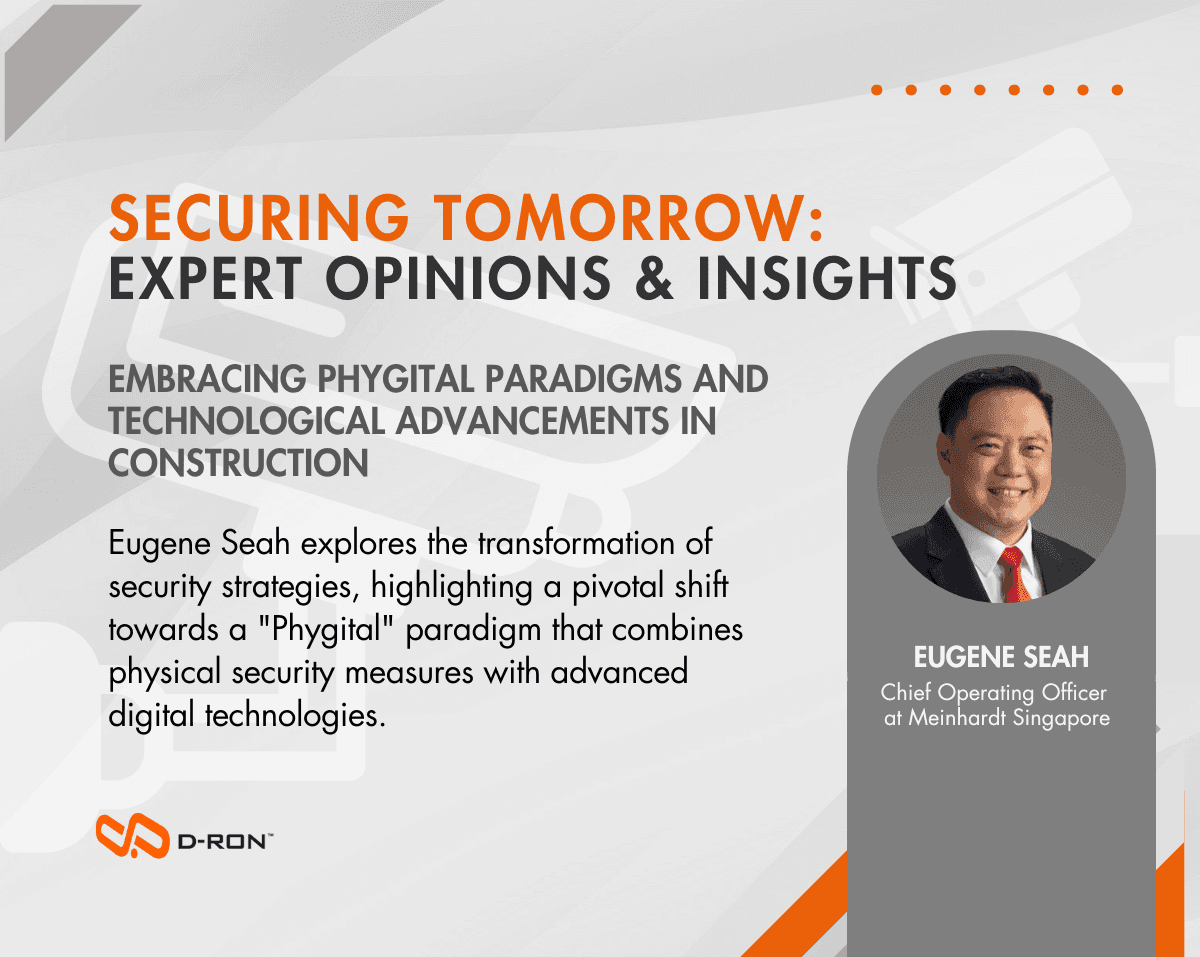
Dr Eugene Seah is a Quantity Surveyor by practice, and he comes from 3 Generations of Quantity Surveying starting from his grandfather. Apart from Quantity Survey, he has attained qualifications in IT and Computing, Sustainability, Construction Law and Arbitration, and HBS. As an experienced Project Manager and Quantity Surveyor of many large construction projects and as part of his Smart Cities remit, he oversees smart security implementation from a big picture and bird’s eye point of view.
D-Ron: As a project manager overseeing construction or refurbishing projects, what are some evolving security landscape and technological advancements reshaping security strategies within the construction industry as we approach 2024 and 2025?
Eugene: Currently, security measures for construction sites operate within a rather insular framework, with a focus on individual sites. The prevailing approach involves contractors relying on the deployment of security guards, making the process notably labour-intensive. However, it's noteworthy that more progressive contractors are exploring the integration of video analytics. In my team's endeavours concerning smart cities, we are actively engaged in envisioning an advanced security paradigm that employs a Queen Bee approach. Under this approach, when a contractor oversees multiple sites, typically four or five, we implement a system using cameras for monitoring. It's important to highlight that physical security remains a key component of this strategy. The cameras are strategically employed to survey the sites, and the recorded footage is subsequently utilised for in-depth video analytics. At times, the analytics can be on the edge. Following this, we can also establish a central command centre dedicated to security management, essentially providing a command centre as a service (CMaaS) for security purposes. This, in essence, represents the direction I perceive as the future of security management.
D-Ron: So it’s kind of a hybrid between physical and digital?
Eugene: Yes, it’s a Phygital world. It is “P-H-Y-G-I-T-A-L”.
D-Ron: So, it’s kind of a hybrid. But do you see any other evolving trends apart from the one in your company? As you mentioned earlier, there are other companies out there.
Eugene: Indeed, larger companies equipped with comprehensive security services are poised to make significant strides in this direction. Concurrently, smaller and midsize enterprises are also embracing these advancements, albeit on a more modest scale. It is good that the Singapore Government extends some help to Small and Medium Enterprises to aid them in their physical journey and transition.
D-Ron: We understand that as a project manager, budgeting and cost management are under your purview as well. What are some cost and benefit considerations when developing or choosing a security system for a construction project?
Eugene: In most decision-making processes, cost serves as the fundamental and underlying consideration. It is not the main consideration, but it can influence decisions. Solutions must not only be cost-effective but also align practically with the client's needs. Consequently, our approach involves striving for a lump-sum framework, essentially achieving more with fewer resources. This necessitates conducting a comprehensive cost-benefit analysis, comparing the viability of implementing advanced systems against the traditional deployment of four or five security guards. Moreover, considerations extend beyond cost alone; factors such as response time, the information recorded and site layouts for Line of Sight (LOS) are crucial. Maintaining a manned presence on the site, coupled with swift response times, is essential. Therefore, these pragmatic considerations encompass not only cost but also safety, response time, service level agreements (SLA), and resilience. To illustrate, if the entirety of the security infrastructure is digitised, potential issues like blackouts or insufficient backup generators must be taken into account. In such cases, having personnel on-site ensures immediate and hands-on problem-solving, in contrast to relying solely on a robot that might be vulnerable to toppling. I was actively involved in the evaluation of a robot. However, numerous challenges arose during its practical application – stringent conditions such as a lack of mud, sand, or dust, and the avoidance of rainy weather posed limitations. Consequently, I concluded that deploying such a robot on-site was unfeasible due to its inability to handle real-world construction site conditions effectively. Additionally, while robots may navigate staircases, a significant caveat is that the staircase must be smooth for the robot to gain a secure footing. However, the reality is that construction sites seldom feature smooth staircases, rendering the use of robots impractical in such environments.
D-Ron: I do think that there's still a bit of a gap between where technology currently is and where it can move towards, especially for this.
Eugene: Yeah, I agree. But we need to embrace it, seeing that our population is aging and not many people want to come into this industry for various reasons.
D-Ron: Okay, so I understand from what you just mentioned in terms of costing and budgeting – those are always key factors – would you then say that based on the other things you mentioned, a security system being the cheapest will not solely be the reason for its selection?
Eugene: Indeed, the selection of a security solution should be grounded in its tangible benefits and practical applicability. It is imperative not to adopt a solution and then seek a problem but rather to begin with a well-defined problem statement and subsequently explore suitable solutions. Furthermore, an alternative technology worth considering is Smart Lighting on a platform, where the light fixtures on the site can function as security sensors, detecting movement. This innovative approach is currently under study within our team. I encourage you to explore this all-encompassing Smart Lighting concept. In collaboration with local companies and our Dutch partners, I am actively engaged in advancing this technology. I can facilitate the connection between D-Ron and this innovative Smart Lighting technology, fostering potential collaboration if there is interest.
D-Ron: Great, Thank you! How should project managers collaborate with security system vendors in designing security systems for a construction project?
For example, ensuring that different security systems from different manufacturers work together could be a technical challenge.
Eugene: The role of overseeing technological considerations in security systems does not typically fall under the purview of a Consultant Project Manager; rather, it aligns more closely with the responsibilities of the Contractor's Digital Manager. Consultant Project Managers primarily focus on project submissions and overall project management. In contrast, in our capacity as providers of Programme and Project Management Office (PMO) services, we extend our oversight to encompass digital and technological aspects. Having said that, I am aware that the Institutes of Higher Learning (IHLs) are also teaching Project Managers on the use of Digital and Technology, readying them for the future economy. In managing these considerations, we delve into various criteria, including interoperability, plug-and-play capabilities, edge computing, and the cost of storage. Storage, in particular, is a critical factor to address. For example, while video analytics can generate extensive data, the challenge lies in determining where and how to store this voluminous information. Additionally, we evaluate the software needed to analyse and scan videos, especially in scenarios where there is a disproportion between the number of guards (one or two) and the multitude of screens (200). Video analytics (VA) presents a noteworthy advancement, where the programme autonomously scans and highlights anomalies in the videos. This technology significantly aids in managing the surveillance workload, especially when dealing with a large number of screens. In essence, our approach involves establishing a comprehensive framework that strives to strike a balance between pragmatism, practicality, cost-effectiveness, functionality, and other relevant considerations. This framework serves as a guiding principle in navigating the complexities inherent in the integration of security systems.
D-Ron: In other interviews, we did speak with some people and they mentioned that a lot of the time, the guards can be rather distracted doing their own things as well, whether it is looking at screens, looking at their phones, or whether there's a new inquiry coming in.
So, sometimes, systems can still do a better job than guards in that sense. But you still need a human person.
Eugene: The indispensable need for human presence persists because a robot cannot adequately fulfil the nuanced responsibilities required for thorough investigation. Cameras, while valuable, may still have blind spots and limitations. However, the contemporary landscape of security requirements has expanded significantly to encompass social, cyber, and noise considerations, as well as the need for clear and incontrovertible evidence. Addressing these multifaceted requirements necessitates meticulous planning, a resilient architectural framework, and a strategic investment plan to seamlessly integrate these elements into a unified platform. The evolution in security demands has shifted from historical tenders that primarily emphasised physical security requirements. Presently, both public and private tenders increasingly include explicit digital security prerequisites to ensure a comprehensive and modern approach to security measures.
D-Ron: What are the main considerations when choosing security systems and vendors for projects?
You mentioned quite a few things just now. For example, the brand, the functionality of the systems, or the vendors in terms of their reputation.
Eugene: Yes, the considerations in selecting security systems are myriad, and in tandem with those considerations, numerous brands offer solutions. When compiling a comprehensive list, one would need to account for approximately 15 to 20 key factors. These include aspects such as uptime, reliability, maintenance efficiency, data compression capabilities, and analytics functionalities, among various others. The breadth of these considerations underscores the complexity of the decision-making process in choosing an optimal security system and brand.
D-Ron: Out of all the things that you just mentioned, what would be the top three for you?
Eugene: Prioritising the selection criteria, I would place function at the forefront, closely followed by cost. Envisioning this prioritisation, aligns with a tree Venn diagram that encapsulates the interplay between function, cost, and quality. This structured approach ensures a comprehensive evaluation, emphasising the functional effectiveness, cost-efficiency, and overall quality of the chosen security system.
D-Ron: How should project managers manage technological changes and scalability in security systems? Because as time passes, your security needs may change. So project managers as a result must plan for the scalability of security systems to accommodate for future growth or modification.
So how do you feel is a good way to manage these changes?
Eugene: Ensuring the adaptability and effectiveness of security systems demands a multi-faceted approach. Firstly, having a dedicated research team or individuals continually at the forefront, ready to comprehend and integrate emerging changes, is crucial. Secondly, expertise in understanding existing processes is paramount. Individuals possessing an in-depth knowledge of these processes are essential in augmenting them to align seamlessly with technological advancements. Thirdly, the careful consideration of hardware-software compatibility is vital. Not only should the technology be interoperable, but it must also be scalable to ensure sustained relevance. This foresighted approach ensures that what is functional in 2023 remains viable and accessible in 2033, preventing issues like file readability obsolescence.
D-Ron: And I guess the vendor also plays a role where the vendor has to be constantly evolving as well.
Eugene: Absolutely. The role of a vendor extends beyond conventional participation in security conferences; they must also adopt a holistic perspective, exploring alternative avenues such as biomimicry. For instance, investigating the feasibility of utilising a camera modelled after the multi-dimensional vision of a fly's eye can lead to innovative solutions. In the current landscape where AI operates at the edge, it presents significant advantages. However, this dependency on edge computing underscores the importance of vendors addressing potential vulnerabilities, such as the creation of blind spots when a camera is removed and the absence of adequate backup. Vendors are tasked with demonstrating a comprehensive understanding of their innovations and effectively communicating their latest research. This includes showcasing how their solutions seamlessly integrate with diverse systems, platforms, Open Data Platforms (ODPs), common data environments, and other frameworks. Moreover, they should illustrate how the data generated can be leveraged for insightful analysis of current and future trends without necessitating an excessive increase in data storage space. Lastly, vendors must provide insights into the role of cutting-edge technologies like quantum computing. This includes addressing questions such as whether these technologies enable the monitoring of sites globally from a Central Command Centre, backed up by resilient cloud technology.
D-Ron: Of course. And at the same time, they are to communicate in a way that is very clear for the end client as well.
Eugene: Absolutely, the relentless pace of change underscores the imperative for businesses to embrace digital and technological advancements as essential components of their operations. In this dynamic environment, staying abreast of emerging technologies and integrating them into business strategies is not just a choice but a fundamental necessity for sustained relevance and competitiveness.
D-Ron: Got it. Thank you so much for your time.
ABOUT EUGENE SEAH
Eugene Seah is an exemplary individual who wears many hats elegantly — a vital quality for an excellent project manager. Having obtained a sound family and educational background in Quantity Surveying, he forged ahead to complete degrees in IT and Computing, Construction Law and Arbitration, Sustainable Building Design, Business Administration, and Construction Management. He has attained his Professional Doctorate in Construction Management at the European International University and PhD by Portfolio from the Swiss Business School.
Eugene’s interdisciplinary competence is what has brought to bear while serving in the past as Managing Director for reputable firms like Davis Langdon & Seah, Surbana Jurong Pte Ltd., and currently as the Chief Operating Officer and Global Board Member of Meinhardt Group, a respected construction engineering firm known for developing quality urban landmark projects across the world.
Eugene injects sustainability, digital, value management and green approaches into his work to achieve project efficiency. He is passionate about resilience in cities and how digital and technology can be leveraged to help citizens in these cities have a better quality of life. He has equipped himself with a Law Masters to ensure the contractual side of Smart and Construction is covered.
His zeal to transmit knowledge and develop the next generation of talent is reflected in the voluntary positions he holds in the National Youth Achievement Award Council, buildingSMART Singapore, the Singapore Institute of Surveyors and Valluers and the Society of Project Managers. You can visit his LinkedIn page to obtain more additional details.